Search. Inspect. Fetch.
A Boolean search–inspect–fetch method for deep-search agents: the agent skims before it reads. Sieve is one setting of the SkimSearchAgent library.
Higher accuracy, with a third to half fewer tokens
Against the BM25 Search-Visit baseline under identical budgets (k=5, 12,000-token reads, 100 steps). Skimming structure before reading is not an accuracy-for-cost trade: on all three collections it wins on both axes.
- −32.4%
- tokens per episode on BrowseComp-Plus, at +2.5 judge points
- −50.6%
- tokens on MuSiQue, at +3.1 EM. The saving grows where the baseline reads most
- 3/3
- collections where Sieve improves accuracy and cuts cost
Accuracy
Tokens / episode
These are the paper's numbers, in the paper's setting. The library's leaderboard uses a different fixed setting, so its BM25 row is not comparable with the baseline here.
The effect transfers across agent backbones (Qwen-AgentWorld, OpenResearcher), with the largest savings where the baseline burns the most context. Full tables, ablations and statistics are in the paper.
Skim the structure, read only what matters
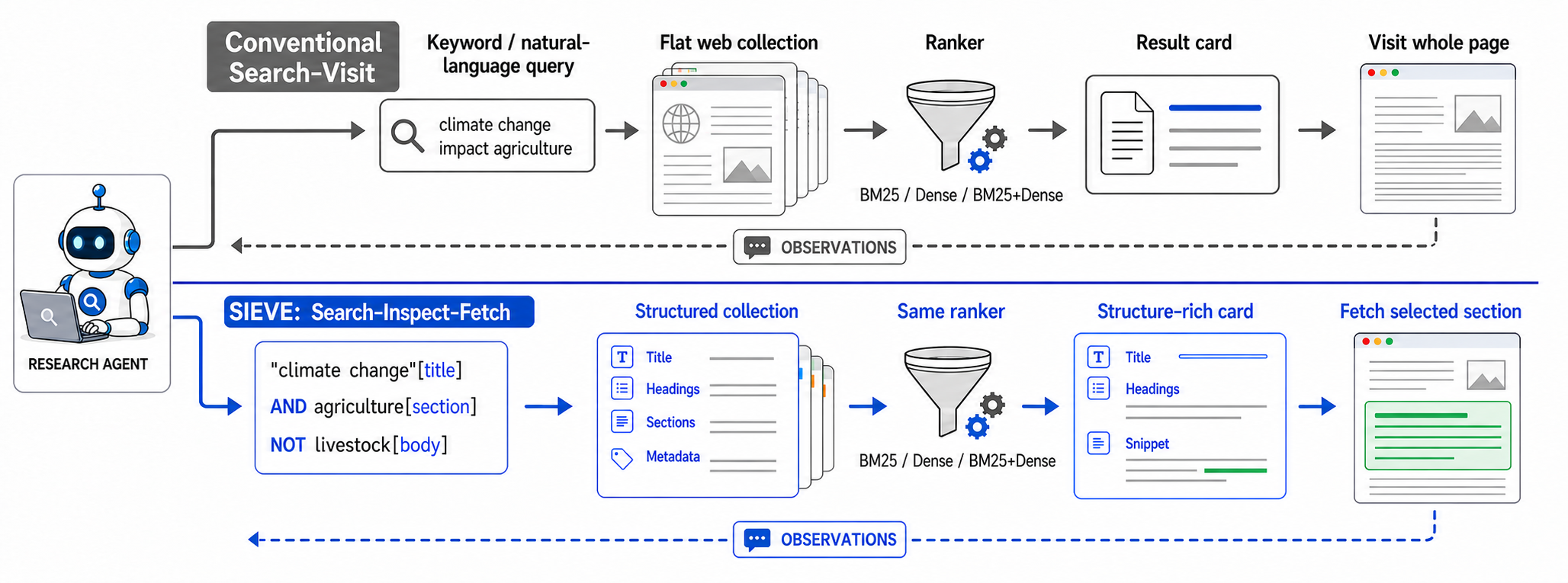
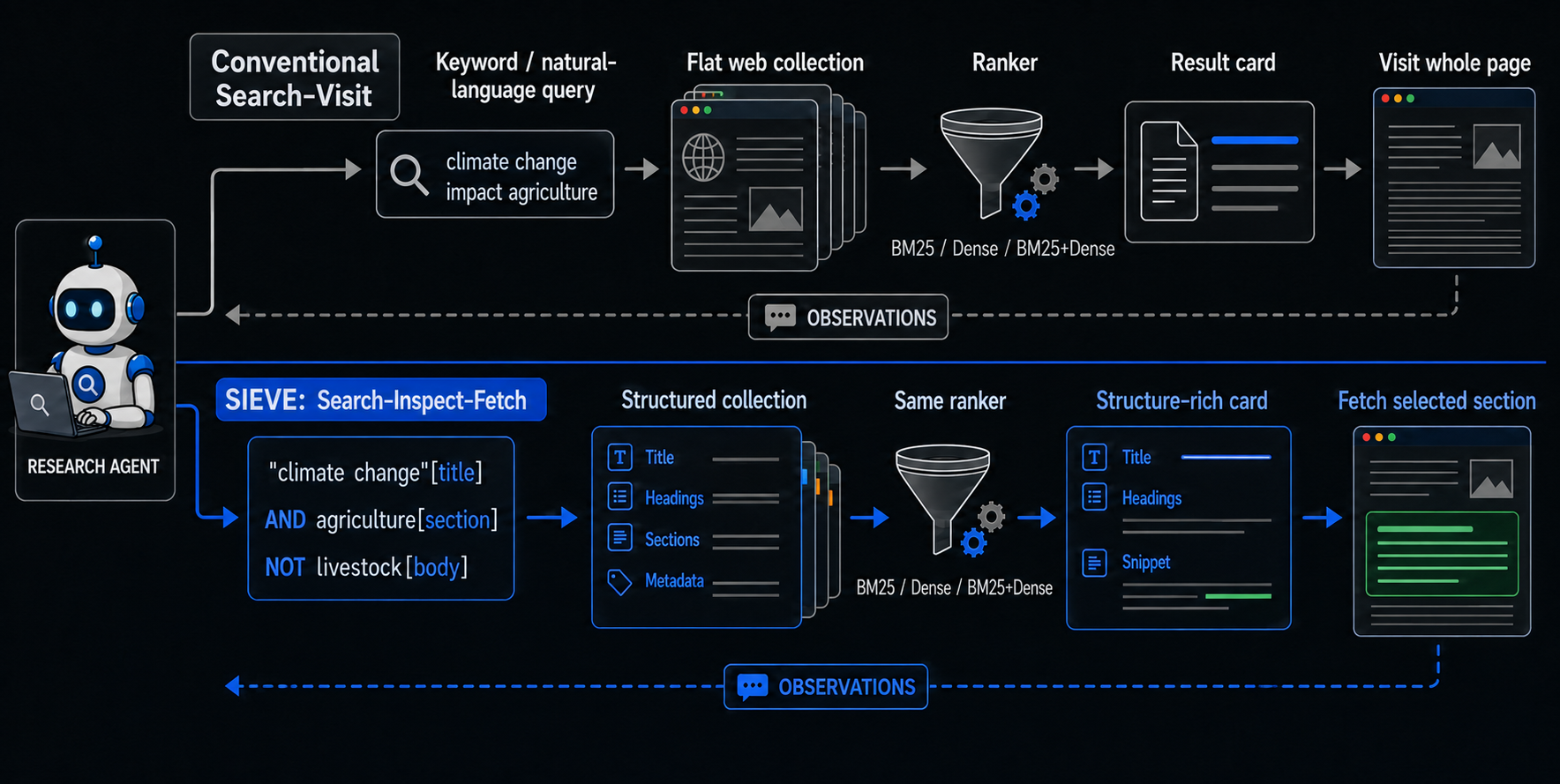
A deep-research agent that reads whole documents burns its context window on text it never needed. Sieve composes four separable stages on top of one shared agent loop, so the agent narrows before it spends.
- 01
Filter
The agent writes a BQL Boolean query: field-scoped terms (
title,section,date…) withAND/OR/NOT, phrases and prefixes that carve the corpus down to candidates. - 02
Rank
Candidates are ranked by relevance, with graceful soft fallback when a strict filter over-narrows to zero hits.
- 03
Inspect
Each result is a structure-rich card: title, section headings, matched fields, a query-biased snippet. Enough to judge a document without reading it.
- 04
Fetch
The agent reads only the named section it chose from the card, a slice rather than the whole document, and answers from grounded evidence.
Built at ielab


If you use Sieve or the library
@misc{wang2026sieve,
  title         = {Search, Inspect, Fetch: Exploiting Boolean Retrieval
                   for Deep-Research Agents},
  author        = {Wang, Shuai and Chen, Haodong and Yin, Yu and
                   Zhuang, Shengyao and Koopman, Bevan and Zuccon, Guido},
  year          = {2026},
  eprint        = {2608.02751},
  archivePrefix = {arXiv},
  primaryClass  = {cs.IR},
  url           = {https://arxiv.org/abs/2608.02751}
}